Wednesday, April 13, 2016

Mystery Reader 3: A Former Student and Big Brother

This Mystery Reader revealed that he was in Mrs. Howard's class for 2 years, his favorite sport is baseball, and he loves reading.  I was thrilled when Peyton came to me and said he wanted to be a Mystery Reader.  Peyton was such an awesome student to have as both a 1st grader and 2nd grader.  He was a hard worker who loved all things non-fiction.  He's been an avid reader ever since 1st grade!  It was great to have you back in our room to share a story all about dogs with our class!
I love little brother's face here!  Look how happy he is to have his big brother surprise us!


Sunday, April 10, 2016

Mystery Reader 2!

This Mystery Reader is a teacher who loves sports and also coaches.  He also happened to be on spring break this last week so coming into 2nd grade to share a story was perfect timing.  Although there were a few other guesses of Mr. Semmen or Mr. Clarke, it was actually Mr. Howard.

He read "Randy Riley's Really Big Hit" by Chris Van Dusen.  Mr. Howard chose this book because it was about sports but also physics.  Since he is a physics teacher, it was a perfect choice!

Thanks for stopping by Mr. Howard!


Saturday, April 9, 2016

Properties of Matter

This week we learned about the properties of matter.  We've already learned that everything is made of matter and distinguished the difference between the molecules in a solid, liquid, and gas.  The students had a lot of fun acting out the tightly packed slow moving molecules in a solid, the more spread out molecules of a liquid, and the highly energetic molecules in a gas.

The properties of matter is what makes everything different from each other.  From taste, to sound, to texture, and size, and much more.  We explored the properties of a trail mix to document the different properties we observed in a pretzel, marshmallow, M&M, and a goldfish cracker.

On Friday we took it a step further and focused on density.  This can be a tough topic to completely understand as a young student.  We defined it as how much matter is packed into an item.  An example was given of an empty car.  The car was then filled with a whole bunch of kids.  That car is now more dense.

We learned that more dense items will be heavier than less dense items.  Using this concept, we made a rainbow in a jar.  We had to layer the liquids based on most to least dense.  The last layer is the trickiest because it's very easy for the olive oil and the rubbing alcohol to mix.  The students loved putting our rainbow together and watching the layers form!

They want to try it again on Monday!  I will send home directions with the kids in case anyone wants to give it a try at home.


Wednesday, April 6, 2016

Mystery Reader 1!

Our first mystery reader has a dog, has only been in 3 states, and loves the movie "The Game Stands Tall."

A few students guessed their dads or their grandpas.  Some thought it was maybe Mrs. Swier until she said that she's been in many states.

Our first mystery reader was Mason!  As soon as he saw that it was time for our mystery readers to begin he knew he wanted to be the first one.  He read "Dog vs. Cat" by Chris Gall, and he did such a great job!  Mason was so interactive with the class as he asked them to draw on their own experiences with pets.  I loved having you visit 2nd grade for a short while Mason!


Friday, March 18, 2016

Engineering an Egg Drop

In our engineering unit, we've learned that engineers need to use creative ideas to build or take things apart.  They also need to be great problem solvers who are willing to try things in a new way if they don't work the first time.

In order to put these skills to use, the students built an egg drop box with a few limited supplies.  Each group was given a shoe box filled with 1 toilet paper tube, 5 cotton balls, 1 styrofoam cup, 2 paper towels, 2 popsicle sticks, 2 straws, 2 pipe cleaners, and a roll of masking tape.

On day 1 the students made their box without the egg.  They had to make some assumptions on how the egg would fit into their design. On day 2, the students were given the egg and many groups had to problem solve a new design based on whether or not the egg fit into their original design.

This project also gave the students another chance to collaborate within a partnership or group, which at times can be challenging.

The goal was to keep the egg safe for 3 different heights of dropping.  The students then reflected on why they think their eggs survived the fall or didn't.  We focused on the fact that if our eggs didn't survive, it's not a failure, but rather it's just one idea that didn't work.  This was a fun project!


Sunday, March 13, 2016

Glue Outlined Oil Pastel Project

This last week we completed an art project that involved some new materials and techniques for us.  With spring being in the air, our focus was on creating flowers in our project.  The technique was different than any other project we had done this year.  On a piece of black construction paper, the students drew their floral designs in pencil.  Then we went over the pencil with a thick white glue border.  The glue dried overnight, and over the next few days the students used oil pastels to fill in their flowers.  They loved using the oil pastels because they blend so nicely to make new colors.  This was a very fun project!


Sunday, March 6, 2016

Little Scientists

Since 3rd quarter started we have been diving into our science units.  Our first unit was all about understanding the scientific method.  We discussed the steps of asking a question, forming a hypothesis (or making a prediction), carrying out an experiment, collecting data, and reporting the results.  We did 2 experiments in this unit to practice the scientific method.

In our first experiment we asked the question: "How can we keep bananas fresher longer?"  We set up 3 bananas: 1 in the fridge, 1 in a paper bag, and 1 with plastic wrap around the stem.  The students made their hypothesis. We observed and collected data over the course of a week.  The results between the banana in the bag and the plastic wrap were not that different.  Although once peeled, the banana in the plastic wrap looked the freshest.  The banana in the fridge became brown and mushy very quickly.

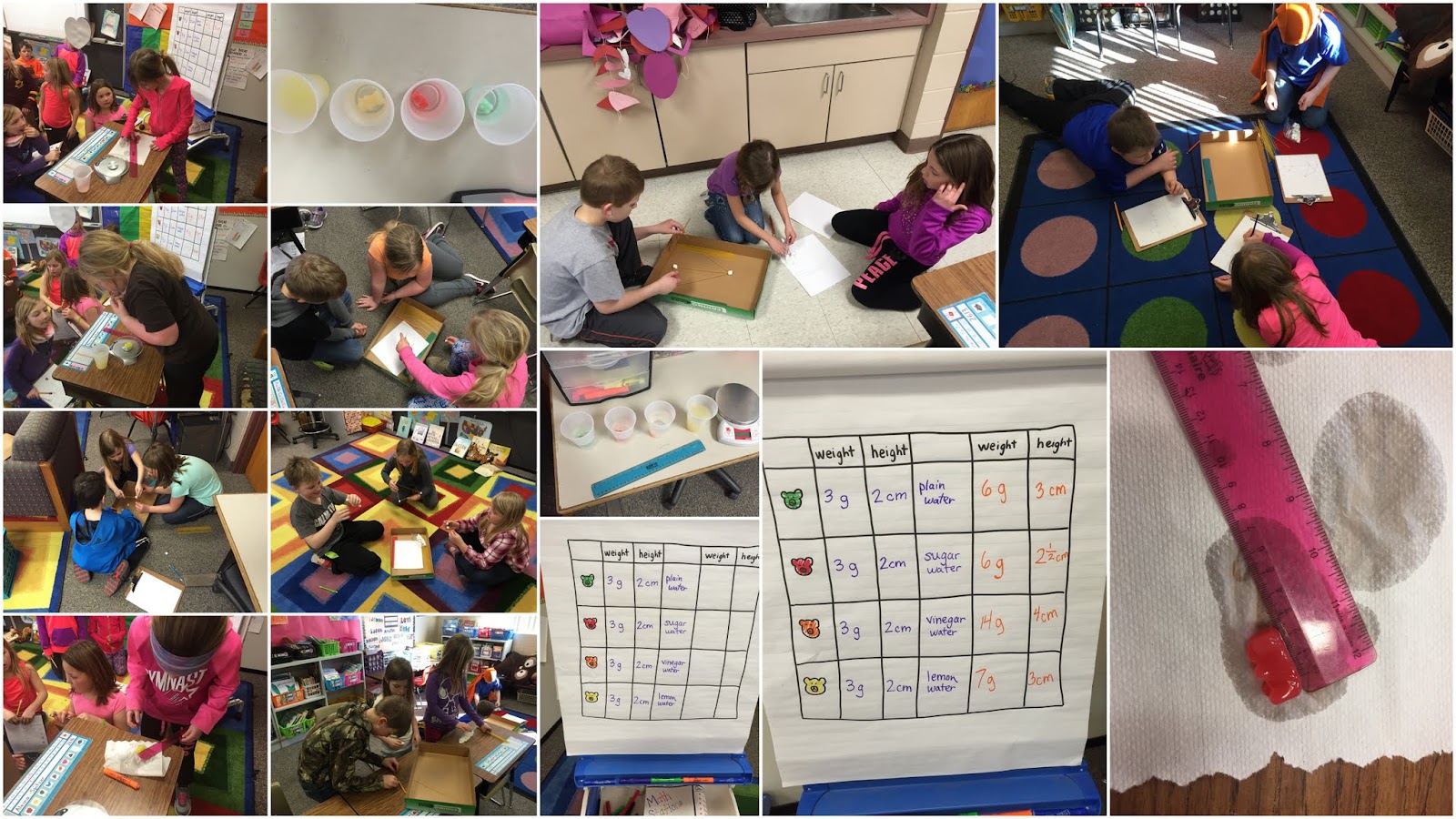
In our second experiment we set out to see if we can make gummy bears grow.  We weighed and measured each bear before putting them in water, sugar water, lemon water, and vinegar water.  We were amazed to find the next day just how much the bear in the vinegar water had grown.

Our next science unit is about engineering.  We are learning that engineers use creative ideas to solve problems.  We've also learned that engineers may create new things or take things apart to see how they work.  Our first task was to make a spaghetti tower using only 30 noodles and 25 marshmallows. The students were placed in groups of 3, and had 2 science class periods to work.

During and after building we had a great discussion about what went well and what was frustrating.  The students noted that when they used encouraging words to each other, they were able to be more creative and more productive.  When they were frustrated with each other or the project, they were not as creative or able to move forward.  We stressed how many ideas didn't work, but you just try something new.  This is such a great lesson that failure happens, but you can also continue to try a new idea.  At one point I heard a student say to her group, "Of course we can do this!  Engineering is all about problem solving!"

We noticed that some groups began building with little trouble on day 1, but found day 2 to be more frustrating because of the limit in supplies.  We also noticed that other groups were more productive on day 2 because they needed more time to think through their ideas. We talked about how these observations of working together can be used in so many parts of our day and lives, not just when we are building spaghetti towers.